Farming Blind in a Volatile Climate
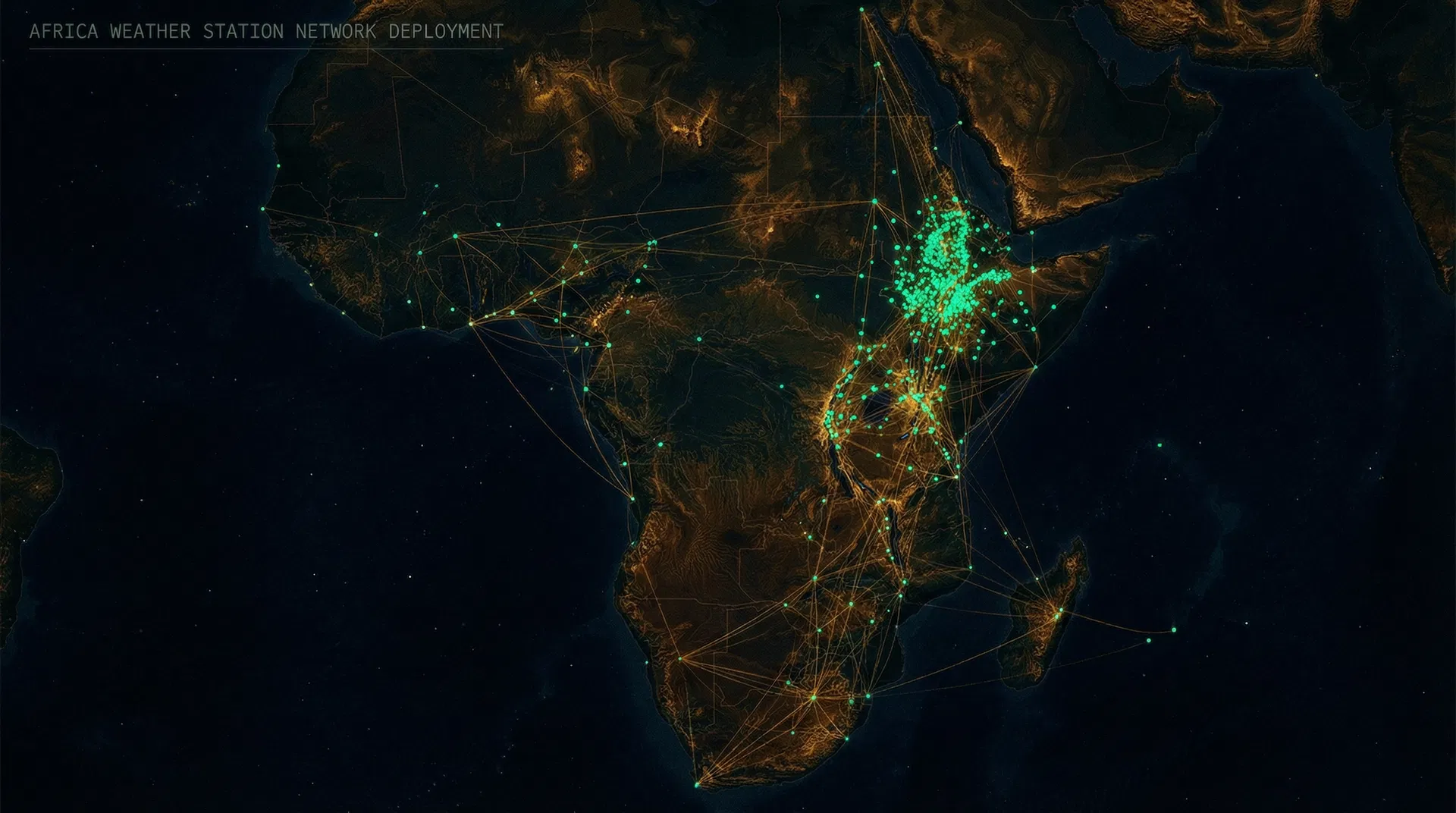
Africa has very poor weather data. The Predictability Index shows Africa as a data desert compared to Europe and North America. With the right infrastructure, data, and leadership, Africa has the potential not only to feed itself but to become a major global food exporter.
Unpredictable Weather
National forecasts cover 50–100 km grids. Individual farms sit in microclimates that no forecast captures.
Pest & Disease Outbreaks
Without local humidity and temperature data, fungal diseases and pest pressure hit before farmers can react.
Water Mismanagement
Irrigating on guesswork wastes Ethiopia's richest resource and adds unnecessary input costs.
Yield & Income Loss
Decisions made without data reduce profitability and resilience, with no financial safety net.
Two-Tier Deployment Architecture
A systematic approach leveraging existing telecom infrastructure to build Africa's most comprehensive weather intelligence network.
Tier 1 — Synoptic Backbone
~3,000 stations on cell towersMounted on Ethiopia's existing ~10,000 telecom towers with 80–100 km grid spacing. Provides the national weather backbone for calibration, aerial services, and hydrology.
Clients & Services
Tier 2 — Agricultural Zones
~4,000 stations on schools, villages, farmsPlaced on schools, villages, and large farms with 15 km grid spacing. Delivers hyper-local crop advisory, disease models, and precision farming data directly to farmers.
Clients & Services
Tower Sharing Infrastructure
~10,000 existing telecom towers across Ethiopia. Ethio Telecom and Safaricom already share towers. Tower-sharing cuts infrastructure costs by 60–70%. Weather station co-location requires zero new land acquisition. Security, internet backhaul already exist. Station density matches agricultural zones perfectly.
Critical Use Cases
Return on Investment
Optimal Seeding Time
Soil temp ≥10°C + rainfall probability >60% + frost-free window = SMS alerts to farmers.
Plant Protection
Humidity >80% + temp 15–25°C = fungal risk model activation. Targeted spray windows.
Fertilizer Application
Rain event 5–10mm forecast in 48h = optimal uptake window.
Harvest Weather
3-day dry window forecasting for combine harvesting. Grain moisture <14%.
Regulatory Compliance
Logs pesticide application conditions. Timestamped evidence for audits.
Irrigation Management
Monitor Soil Moisture, ET and WFC — water when needed, TIME and QUANTITY.
Investment Timeline
Phase 1 — Pilot
Phase 1 — Scale
Phase 2 — Continental
Network Coverage
Before and after: from data desert to connected intelligence